Evangelical Reflections - Saturday of the First Week of Lent - February 27, 2021

February 27, 2021

Saturday of the 1st Week of Lent

Matthew 5:43-48


I like to sum up today’s Gospel in one word: yikes!


Why “yikes”? Because Jesus tells us to be perfect, just as our Heavenly Father is perfect. I’m not sure about you, but I know that I fall short of perfect every single day. Perfect is a tall order.


However, Jesus tells us exactly what we need to do in order to be perfect: we have to love our enemies. We have to love those who don’t love or like us, those that persecute us. I look around at the world today and I’m not sure that many of us are even giving this perfection a try (myself included). All it takes is to look at one social media political article and BAM, there’s hatred and negativity everywhere.


Think about a person or group of people right now that just makes you angry. Maybe they have different political beliefs than you or some other reason. Now ask yourself, “when was the last time that I listened to that person?” And when I say “listened”, I don’t mean that they were talking and I was already thinking of my response in my head. I mean to really listen, to put myself in their shoes. Sometimes all it takes to bring love into a situation is to listen and allow the other person to be heard.


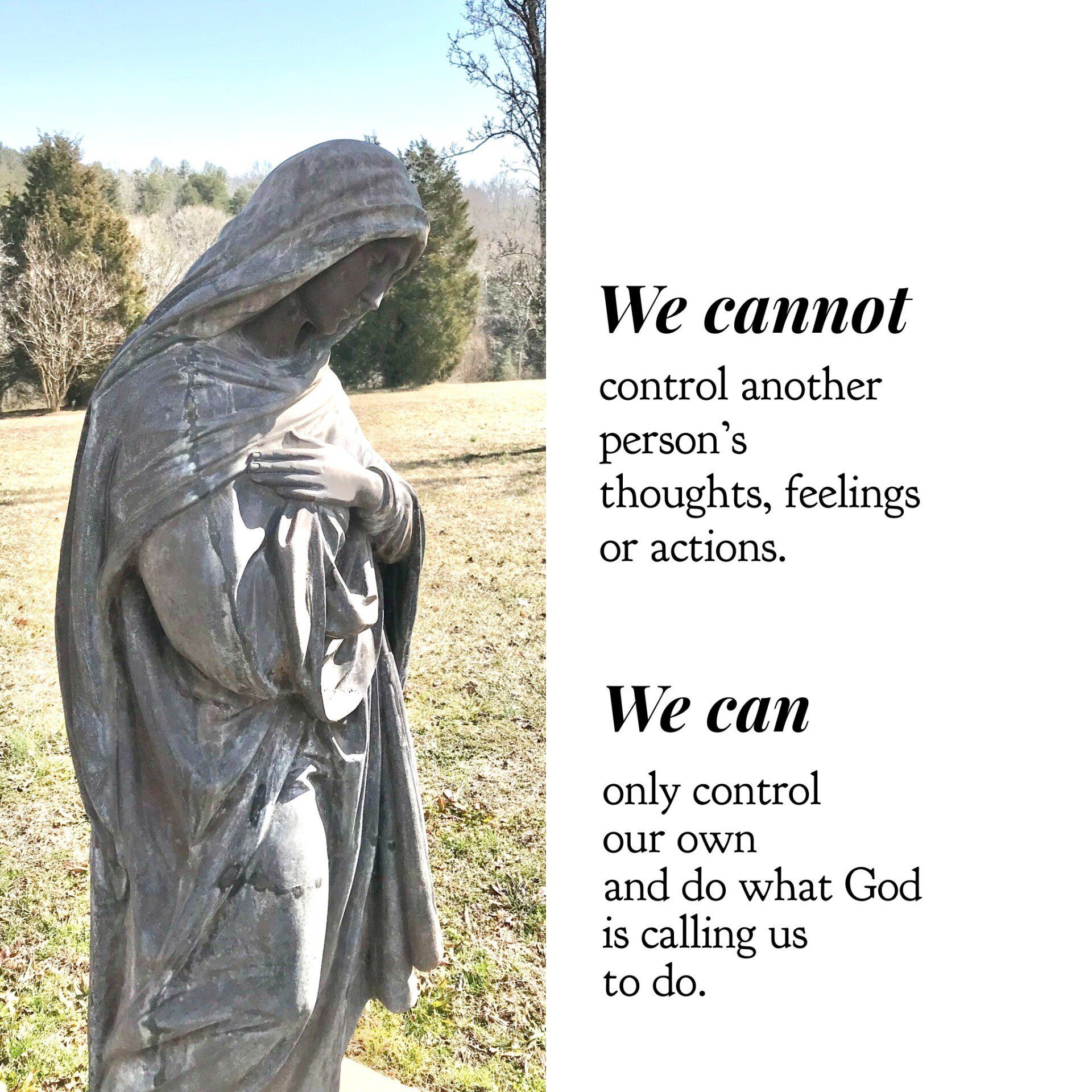
We may say, “but they don’t listen to me, why should I listen to them?” And to that, Jesus would say, “if you love those who love you, what reward is there in that?” We cannot control another person’s thoughts, feelings or actions. We can only control our own and do what God is calling us to do.


I know in my own life when I have backed down and truly listened to what someone is saying that I disagree with, my whole attitude towards them has changed. I usually will not agree with them still, but my heart has been softened and I am able to show that person love and compassion.


Let us ask the Lord to show us His love in our hearts that we may love those who need His love the most, that our enemies may become our brothers and sisters in Christ.

From the Pastor

By John Putnam December 5, 2025
On this Second Sunday of Advent, our second reading from St. Paul’s letter to the Romans encourages us to focus our Advent preparations in this way: “Welcome one another, then, as Christ welcomed you, for the glory of God.” And how does Christ welcome us? With unconditional love. This is the essence of Christian hospitality, a vital aspect of stewardship living. Fully embraced, it has the power to transform our lives and the lives of those who experience it through us. The practice of Christian hospitality is also a way for us stewards to answer the call of John the Baptist, in our Gospel passage from Matthew. His words apply just as much to us today as they did to the people awaiting the Savior’s arrival. John says, “Repent, for the kingdom of heaven is at hand!” And he recalls the words of the prophet Isaiah, “Prepare the way of the Lord, make straight his paths.” There is a definite connection between repentance and effective hospitality. So how can we make repentance a regular part of our everyday lives? We can make an “examination of conscience” a daily part of our prayers, thanking God for the times we said “yes” to Him, and asking forgiveness for the times we chose our own will. We can (and should!) go to Confession this Advent. We can reach out to a family member or friend where there is distance or discord and make peace. As we “straighten the paths” of our own hearts and minds, we become more hospitable people, better stewards of God’s grace and mercy, and far more open and ready to invite others into our lives, homes, and parish. This is preparation fitting for our merciful Savior. © Catholic Stewardship Consultants, 2025 Pastoral Pondering Pope Leo XIV, the 267th Bishop of Rome, undertook his inaugural apostolic journey abroad from November 27 to December 2, 2025. This six-day itinerary encompassed Turkey (November 27–30) and Lebanon (November 30–December 2), marking a deliberate choice of destinations in the Middle East amid ongoing regional conflicts and global ecclesiastical anniversaries. As the successor to Pope Francis, who had planned a similar trip before his passing in April 2025, Leo XIV’s voyage fulfills a commitment to ecumenical and inter-religious engagement while advancing themes central to his nascent papacy: peace, unity, and dialogue. Historical and Ecumenical Significance in Turkey The Turkish leg of the journey centered on İznik (ancient Nicaea), where Pope Leo XIV participated in commemorations of the 1,700th anniversary of the First Council of Nicaea (325 AD). This ecumenical council, convened by Emperor Constantine I, produced the Nicene Creed—a foundational statement of Christian faith affirming the divinity of Christ and shared by Catholic, Orthodox, and Protestant traditions. The event underscored the common heritage of Christianity, with Leo XIV joining Ecumenical Patriarch Bartholomew I of Constantinople for a joint declaration and doxology at the Patriarchal Church of Saint George in Istanbul. This collaboration highlights efforts to bridge the schism between the Catholic and Eastern Orthodox churches, echoing historical papal visits to Turkey (e.g., by Popes Paul VI in 1967 and Benedict XVI in 2006). In a broader context, the visit to predominantly Muslim Turkey (where Christians constitute less than 0.5% of the population) served as a gesture of interfaith outreach. Key moments included a prayer at Istanbul’s Blue Mosque—though Leo XIV refrained from visibly praying there, distinguishing his approach from predecessors—and a meeting with President Recep Tayyip Erdoğan. Discussions addressed tensions over sites like the Hagia Sophia, reconverted to a mosque in 2020, and emphasized mutual respect amid Turkey’s role as a crossroads of early Christianity and St. Paul’s homeland. The pilgrimage thus reinforced the papacy’s commitment to fostering “what unites us” over divisions, as articulated by Vatican spokespersons. Humanitarian and Diplomatic Significance in Lebanon Transitioning to Lebanon, Pope Leo XIV’s itinerary addressed the nation’s profound challenges: economic collapse since 2019, the devastating 2020 Beirut port explosion (which killed over 200 and displaced thousands), and renewed violence from Israeli airstrikes in 2024 targeting Hezbollah positions, despite a fragile Gaza ceasefire. Lebanon’s Christian community, the largest in the Arab world (comprising 30–35% of the population), faces emigration and instability, making the visit a vital affirmation of solidarity. Notable engagements included meetings with President Joseph Aoun, Parliament Speaker, Nabih Berri, and Prime Minister, Nawaf Salam; an inter-religious prayer at Beirut’s port memorializing explosion victims; and visits to the tomb of St. Charbel and the statue of Our Lady of Lebanon. An open-air Mass at Beirut’s waterfront, anticipated to draw 120,000 attendees, symbolized communal resilience. Hezbollah leader Naim Qassem extended a formal welcome, delivering a letter via group members and framing the visit as an opportunity for dialogue on regional peace. This outreach to Muslim-majority Lebanon (65–70% Muslim) amplified Leo XIV’s message of coexistence, drawing parallels to Pope John Paul II’s 1997 visit and Benedict XVI’s in 2012 amid the Syrian civil war. Broader Geopolitical and Papal Implications Occurring against the backdrop of a “piecemeal” third world war—encompassing Ukraine, Gaza, and Middle Eastern flashpoints—Leo XIV’s journey positioned the Holy See as a moral voice for de-escalation. In addresses, he invoked his predecessor Pope Francis’s warnings on humanity’s endangered future, urging world leaders to prioritize peace negotiations. The trip’s timing, covered by over 80 journalists from 15 countries (including major U.S. networks), amplified its global resonance, particularly as the first foreign voyage of an American pope. Symbolically, selecting Muslim-majority nations for his debut underscores a pontificate rooted in Augustinian spirituality (Leo XIV being the first from the Order of Saint Augustine) and social teaching, echoing Pope Leo XIII’s emphasis on justice in industrialized eras. It signals continuity with Francis’s bridge-building while introducing Leo XIV’s vision: unity across faiths, support for persecuted minorities, and advocacy for the vulnerable. By December 2, 2025, the visit had already prompted reflections on its potential to influence fragile truces and inter-communal harmony in the region.  This apostolic journey, therefore, transcends ceremonial bounds, serving as a strategic affirmation of the Catholic Church’s role in promoting global stability and religious solidarity.
By John Putnam December 2, 2025
Today we begin the beautiful season of Advent — a season of preparation. For what are we preparing? The celebration of the birth of our Savior, and the anticipation of His second coming. These are weighty tasks with eternal consequences. So, let us as Christian stewards make the words of the Prophet Isaiah our motto for the season: “Come, let us climb the Lord’s mountain to the house of the God of Jacob, that he may instruct us in his ways and we may walk in his paths.” In the weeks leading up to Christmas, it seems everywhere we turn we are pushed to spend more, do more, entertain more, and generally rush around at a frantic pace — all to create a “perfect” Christmas day. In contrast to this worldly pressure, the Church’s guidance to use these weeks as a time to focus on our spiritual lives can indeed seem like a mountain climb. But the intentional and wise use of the gift of time is exactly what the Christian steward is called to do, and with even greater intensity during Advent. How can we use our time to prepare for a holy celebration of Jesus’ birth on Dec. 25 and for his second coming at a date we do not know? We can push back against the world’s pressure to have the “perfect Christmas.” Scale back on the material kind of gift-giving, the complicated menus, the unessential trappings of the season so that we have more time for the spiritual preparations: Confession, weekday Mass, adoration, family prayer time, lighting the Advent wreath, acts of kindness. It may feel like a mountain climb, but in the end, we will be prepared to celebrate a truly meaningful Christmas, we will have become more like our Savior, and we will be ready for Him to come again. Let’s go climb the Lord’s mountain! © Catholic Stewardship Consultants, 2025 From the Pastor Advent brings a time of new beginning. A new liturgical year is upon us, but it is also a time to prepare our hearts for something – for the coming of the Lord. The first weeks of Advent focus on the Lord’s coming at the end of time, and the latter weeks of Advent focus on preparing to celebrate His coming at the Nativity. Both, however, are interconnected. The first coming of the Lord facilitates His coming into our hearts, which, in the end, facilitates His second coming to judge the living and the dead. The “in between” of these two comings is where time and eternity come together. We are called to live each day in expectation of His coming. We are called to hope for His coming and to expect it even when it seems long delayed. It is in this expectation that we must learn to live our lives. Daily life is messy and unpredictable. We must deal with disappointments, sickness and loss. Yet, we do so as people of hope who know that in these crosses, there lies ultimate joy because of the love of the Father who sent his Son to love us to the end. As we begin a new journey in a new liturgical year, let us do so with joyful expectation. Knowing that the end of the journey, if we are faithful, is paradise.