From the Pastor - 5th Sunday in Lent

March 20, 2026

At this point in our Lenten journey, it is tempting to grow weary of the spiritual disciplines we have taken on. Today’s readings inspire us to remain faithful, in grateful response to a God who loves us so much.


In our first reading, the prophet Ezekiel speaks God’s own words to us. “I will put my spirit in you that you may live… I have promised and I will do it, says the Lord.” Our God wants to be so closely united to us that we are one with Him. And He has promised He will do it. But only if we make room for Him by making Him THE priority of our lives. Putting God first is a grateful response that is very pleasing to Him.


How can we do this? Our second reading, from Romans, tells us. “Those who are in the flesh cannot please God. But you are not in the flesh… you are in the spirit if only the Spirit of God dwells in you.”


The disciplines of Lent and a stewardship way of life are wonderful gifts that free us from too great an attachment to “the flesh.” The sacrifices we make as Christian stewards are not meant to restrict our freedom and joy. Quite the contrary. They are tools to help us find the real freedom and joy that only come when we make room in our lives for God. 


As we journey closer to the Passion of our Lord, let us intensify our Lenten resolutions and our stewardship way of life, inviting the Holy Spirit to take over more and more of our lives. By Easter, we will be freer to rejoice in Him and truly pleasing to God. © Catholic Stewardship Consultants, 2026.


Pastoral Pondering

On September 29, 1916, the Angel of Peace appeared to the three shepherd children in Fatima. During this encounter, the Angel shared with the children the following prayer: "Most Holy Trinity, Father, Son, and Holy Ghost, I adore thee profoundly, and I offer Thee the Most Precious Body, Blood, Soul, and Divinity of the same son Jesus Christ, present in the Tabernacles of the world, in reparation for all the sacrileges, outrages, and indifferences by which He Himself is offended. And by the infinite merits of His Most Sacred Heart and through the Immaculate Heart of Mary, I beg of Thee the conversion of poor sinners." In keeping with the theme that I began last week, about reviewing the basics, I thought it might be useful to address the importance of Eucharistic reverence and devotion.

In the prayer given by the Angel, sacrileges, outrages and indifferences are specifically mentioned. Perhaps looking at each of these is a helpful way to address this.
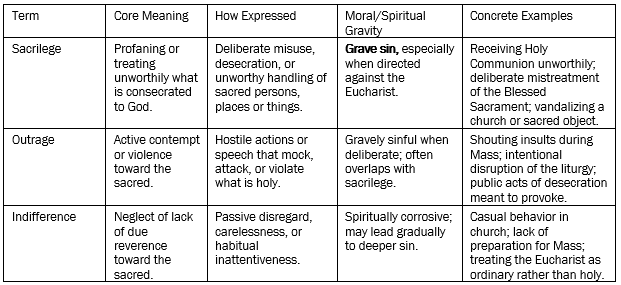
Sacrilege profanes what is holy, outrage openly attacks it, and indifference quietly neglects it—but all three wound our relationship with God and diminish our reverence for His real presence among us. As we continue our Lenten journey, may we ask for the grace not only to avoid irreverence, but to grow in conscious, loving devotion to the Eucharist, responding with faith, gratitude, and awe to the God who gives Himself so completely to us.


From the Pastor

By John Putnam July 10, 2026
In today’s Gospel from Matthew, Jesus shares the familiar Parable of the Sower. It is a powerful image for the stewardship way of life, demonstrating the gradual but transformative effect that a life centered on God can have on us over time. In the parable, some seed falls on a path where birds quickly carry it away. Other seed falls on rocky ground, where it begins to grow but cannot develop deep roots. Still more seed falls among thorns that eventually choke the young plants. Finally, some seed falls on rich, fertile soil and produces an abundant harvest. Jesus explains that the seed is the Word of God, generously scattered for all to receive. The question is whether our hearts are prepared to receive it and allow it to take root. This is where the stewardship way of life comes in. When we offer our time, talent, and treasure to God and place Him first in our lives, we help create the “good soil” needed for the Kingdom to flourish within us. Stewardship removes the “rocks” of mistrust as we grow in confidence that God will provide for our needs. It clears away the “thorns” of worldly concerns that can distract us from what matters most. Through prayer, the sacraments, and generous service, the soil of our lives is continually nourished and renewed. Let us deepen our commitment to this way of life, allowing the Divine Sower to do His work within us. In time, He will produce an abundant harvest through our lives. ©Catholic Stewardship Consultants, 2026. Pastoral Pondering A Pastoral Reflection on the Earthquakes in Venezuela Dear Brothers and Sisters in Christ, In these days, our hearts are heavy as we learn of the devastating earthquakes that struck Venezuela on June 24, 2026. Two powerful tremors, measuring approximately 7.2 and 7.5 in magnitude, have caused great loss of life, injured thousands, and left many families homeless and grieving. As your pastor, I invite you to join me in prayer for all those affected— the deceased, the injured, the missing, and those working tirelessly in rescue and relief efforts. May the Lord grant them strength and comfort in this time of trial. The Catholic Church offers us clear guidance on how to understand such natural disasters. They are not punishments from God directed at specific sins or peoples. As the Catechism of the Catholic Church teaches, our world is “in a state of journeying” toward its ultimate perfection (CCC 310). In God’s wise plan, creation includes both life-giving and destructive forces of nature—such as the shifting of tectonic plates that cause earthquakes. Physical evils like these remind us of the disorder introduced into the world by Original Sin, yet they are not direct divine judgments. Jesus Himself rejected such thinking when asked about tragedies in His time (see Luke 13:1-5 and John 9:1-3). Instead, these events humble us, turn our eyes from fleeting earthly goods toward heaven, and call forth the best in us: compassion, solidarity, and trust in God’s providence. Our Holy Father, Pope Leo XIV, has expressed his deep closeness to the Venezuelan people. He has offered prayers for the victims and their families, entrusted the rescuers to the Lord, and sent an initial emergency donation of €100,000 to support relief efforts through the local Church. He urges the international community to respond with generous solidarity. In moments like this, we remember that creation itself “groans” in labor pains as it awaits full redemption (Romans 8:22). Yet we are not without hope. God does not abandon His children. He is present in the suffering Christ who walks with us, and He brings good even from tragedy—through heroic acts of charity, stronger communities, and hearts turned more fully toward Him. What can we do here at St. Mark’s? - Pray: Offer Masses, Rosaries, or personal prayers for Venezuela. Consider a special intention at weekend Masses. - Help: Support reliable Catholic relief organizations such as Catholic Relief Services (CRS) or efforts coordinated by our Diocese of Charlotte. Even small donations can provide food, shelter, and medical aid. - Reflect: Use this as an opportunity for personal conversion and gratitude for the blessings we enjoy.  Let us entrust our Venezuelan brothers and sisters to the intercession of Our Lady of Guadalupe and St. Mark, our patron. May the Risen Lord bring healing, peace, and hope to all who suffer. And may we, as one parish family, respond with the love of Christ.
By John Putnam July 10, 2026
The theme of humility is central to our readings today. God Himself is a humble God, so if we wish to follow Him as Christian stewards, we too, must be humble. In fact, humility is key to the stewardship way of life, and to a peaceful and fulfilling life. In our Gospel passage from Matthew, Jesus Himself speaks to the Father about the privileged role that humble souls play in God’s plan of salvation. “I give praise to you, Father, Lord of heaven and earth, for although you have hidden these things from the wise and the learned you have revealed them to little ones.” What does it mean to be a “little one”? It means that we acknowledge we don’t have it all figured out, but that we are very much in need of a savior. It means we recognize that all we are and all we have been given is a gift from God. It means we embrace the stewardship way of life. It is not easy, but deep peace and consolation come with this way of life. Jesus offers these warm and encouraging words to entice us to embrace them. “Come to me, all you who labor and are burdened, and I will give you rest. Take my yoke upon you and learn from me, for I am meek and humble of heart; and you will find rest for yourselves. For my yoke is easy, and my burden light.” Let us resolve to follow in the footsteps of our Savior, embracing the humble path of stewardship. It is the path that leads to peace here and now, and ultimately leads us to heaven. © Catholic Stewardship Consultants, 2026. Pastoral Pondering One of the struggles that confessors often have to face is the reality of scrupulosity. It is not something new and has in fact been recognized as a spiritual obstacle throughout the centuries. Hence, I thought a discussion of the issue, albeit brief, would be helpful to those who face it or know someone who does.  Scrupulosity is a condition in which a person experiences excessive, persistent anxiety and doubt about sin, often seeing mortal sin where there is none or obsessing over past faults that have already been forgiven. It is sometimes described as a religious form of Obsessive-Compulsive Disorder (OCD) and can cause great spiritual distress, frequent confessions, and difficulty trusting in God’s mercy. The Church has long recognized scrupulosity as a heavy cross, not a sign of weak faith but a challenge that even great saints like St. Ignatius of Loyola and St. Alphonsus Liguori faced. The Catholic response emphasizes trust in God’s infinite mercy, the reliability of the sacraments, and obedience to a trusted confessor or spiritual director. Key principles include: once a sin is confessed and absolved, do not revisit it; temptation is not the same as consent or sin; and venial sins are forgiven through ordinary acts of love and the Eucharist. If you struggle with scrupulosity, choose one regular confessor, follow his guidance faithfully, and resist the urge to “priest-hop” for repeated reassurance. Professional help from a therapist familiar with OCD and Catholic teaching can also be a valuable complement. Remember the words of Jesus : “Come to me, all you who labor and are burdened, and I will give you rest” (Mt 11:28). God’s mercy is greater than our fears. If you or someone you know suffers in this way, speak with a priest, seek spiritual direction, and know that you are not alone. Resources such as *Scrupulous Anonymous* (a free newsletter) and books like Fr. Thomas Santa’s *Understanding Scrupulosity* can offer further encouragement. May the Lord grant peace to all who carry this burden.